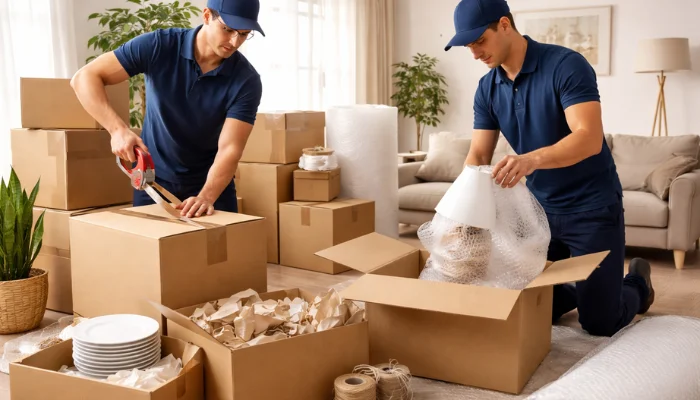
The secret to a smooth, organized, and stress-free move is not just in how you pack, but in how you Label Moving Boxes. A clear, consistent labeling system is the communication bridge between your old home and your new one. Proper labeling ensures that every box ends up in the correct room, that fragile items are handled with care, and that you can quickly locate essentials on moving day.
The Core Principles of Labeling Moving Boxes
Effective labeling goes beyond simply writing the room name on the top of the box. It involves a strategic system that provides information for three key parties: the movers, the unpackers, and the inventory manager (you).
The Three Pieces of Essential Information
Every single box should contain three pieces of information written clearly on at least two sides and the top:
- Destination Room: The room in the new house where the box belongs (e.g., “Master Bedroom,” “Kitchen,” “Office”).
- Handling Instructions: Warnings like “FRAGILE,” “THIS SIDE UP,” or “HEAVY.”
- Contents Summary: A brief, one-line description of the contents (e.g., “Plates & Glassware,” “Winter Sweaters,” “Office Files”).
The Power of Visibility
Use a thick, dark, permanent marker (like a black Sharpie) to write the information in large, bold letters. The labels must be readable from a distance, allowing movers to quickly identify the destination room without having to search for the label. Never write on the bottom of the box, and avoid writing only on the top, as boxes are often stacked.
Read also: https://carrycrew.co.uk/it-office-relocation-london-keep-your-systems-running/
Labeling Intent: Simple vs. Detailed
|
Labeling Method |
Primary Goal | Best For | Unpacking Experience |
|---|---|---|---|
| Simple (Room Only) | Speed and quick placement by movers. | Small, local moves with minimal fragile items. | Chaotic; requires opening every box to find items. |
| Detailed (Room + Contents + Number) | Inventory control, safety, and efficient unpacking. | Large, long-distance, or high-value moves. | Highly organized; allows for priority unpacking and tracking. |
| Color-Coded | Visual speed and organization. | Moves with many boxes and multiple movers. | Movers can place boxes instantly based on color key. |
The Color-Coding System for Moving Boxes
Color-coding is a highly effective hack that allows movers to instantly know where a box belongs without reading a single word. This system is particularly useful in a large move with multiple rooms.
Setting Up Your Color Key
Assign a unique color to each major room in your new house. For example:
- Red: Kitchen
- Blue: Master Bedroom
- Green: Living Room
- Yellow: Office
Create a master key and place a corresponding colored sign on the door of each room in your new house.
Applying the Color Code
You can apply the color code in a few ways:
- Colored Tape: Use colored packing tape to seal the box.
- Colored Stickers: Use large, circular colored stickers on the top and sides.
- Colored Markers: Use a marker of the assigned color to write the room name.
The goal is to make the color instantly visible from any angle.
The Numbering System for Inventory
For ultimate organization, combine the color code with a numbering system. Assign a sequential number to each box (e.g., KITCHEN Box 1 of 25). Keep a master inventory list that correlates the box number with a detailed list of its contents. This allows you to track every box and quickly locate specific items without opening the box.
Color-Coding Guide for Moving Boxes
A consistent color-coding system is one of the most effective ways to Label Moving Boxes for speed and accuracy.
|
Color |
Destination Room | Essential Items to Pack |
Labeling Material |
|---|---|---|---|
| Red | Kitchen | Dishes, Glassware, Pantry Items | Red Tape/Sticker |
| Blue | Master Bedroom | Clothing, Linens, Valuables | Blue Tape/Sticker |
| Green | Living Room | Books, Media, Decorative Items | Green Tape/Sticker |
| Yellow | Office/Study | Files, Electronics, Stationery | Yellow Tape/Sticker |
| Orange | Storage/Garage | Tools, Seasonal Items, Long-Term Storage | Orange Tape/Sticker |
Essential Information and Handling Instructions
Beyond the room destination, the information you write on the box is crucial for both safety and priority unpacking.
Fragile and Heavy Warnings
Any box containing breakables must be labeled “FRAGILE” on all sides. For boxes containing books, tools, or other dense items, label them “HEAVY” to alert movers to the concentrated weight and prevent injury. If a box contains liquids or cleaning supplies, label it “LIQUIDS – KEEP UPRIGHT.”
Priority Unpacking
Create a special designation for boxes you need immediately. Label these boxes “ESSENTIALS – OPEN FIRST” or “DAY 1.” These boxes should be loaded last onto the truck and unloaded first, ideally placed in a designated area of the new home. This simple hack prevents the stress of searching for basic necessities on your first night.
Read also: https://carrycrew.co.uk/office-relocation-services-london-for-modern-businesses/
Essential Labeling Information
Ensure every box contains these three layers of information to maximize organization and safety when you Label Moving Boxes.
|
Information Layer |
Purpose | Example | Location on Box |
|---|---|---|---|
| Destination | Directs the box to the correct room in the new house. | Master Bedroom | Top and Two Sides |
| Handling | Alerts movers to special requirements. | FRAGILE / HEAVY / THIS SIDE UP | All Four Sides |
| Contents Summary | Helps with inventory and priority unpacking. | Winter Clothes & Shoes | Top and Two Sides |
| Box Number | Used for tracking against a master inventory list. | MB-007 (Master Bedroom Box 7) | Top Corner |
FAQs
What is the best way to label moving boxes?
Use clear room names, content descriptions, and handling instructions on multiple sides.
Should I number moving boxes?
Yes, numbering helps track boxes and ensures nothing goes missing.
Do I need to label every box?
Yes, every box should be labeled to avoid confusion.
Can color-coding really help?
Yes, it speeds up unloading and makes unpacking more organized.
Final Thoughts
Learning how to label moving boxes properly can make a huge difference in how smooth your move feels. Clear, consistent labeling saves time, reduces stress, and protects your belongings. By following these simple labeling tips, you can enjoy a more organized and efficient moving experience.